CPD Library
Explore our evidence informed CPD units, organised into key areas for school improvement. Each theme includes multiple CPD units with ready-to-use resources to help you build knowledge, strengthen practice and create lasting impact across your school.

Browse by Category
-

Adaptive Teaching
Every primary classroom contains pupils working below, at, and above age-related expectations, including those with SEND — yet differentiation by task can quietly narrow the curriculum rather than support genuine access to it. This session explores what adaptive teaching actually means, why constant one-to-one support can increase dependency rather than close gaps, and how five practical strategies keep every pupil working towards the same ambitious objective — giving whole-staff teams a shared, evidence-informed language for inclusion.
[[BIGPICTURE]]
Adaptive teaching means changing how a lesson is taught, not what is taught — through scaffolding, questioning and modelling that flex to each pupil in the moment. Every learner works towards the same ambitious objective; only the level of support and the route there differ.[[/BIGPICTURE]]
[[EVIDENCE]]
EEF (2020) on high-quality teaching for SEND being high-quality teaching for all; Rosenshine (2012) on scaffolded questioning and guided practice; Webster and Blatchford (2015), whose DISS project found pupils with constant one-to-one TA support often progressed least; and Ofsted's SEND Review (2021) on inconsistent provision nationally.[[/EVIDENCE]]
[[THE CLASSROOM IMPACT]]
Teachers replace fixed ability groups and permanently simplified tasks with flexible, task-based grouping and planned, removable scaffolds. TAs prompt and question rather than complete tasks for pupils. Pupils spend more time attempting the same objective as peers, and support visibly reduces as their independence grows.[[/THE CLASSROOM IMPACT]]
[[PERFECT FOR]]
Schools looking to raise expectations for pupils with SEND, reduce dependency on one-to-one adult support, and give every child genuine, growing independence in accessing the same ambitious curriculum as their peers.[[/PERFECT FOR]]
[[KEYWORDS]] adaptive teaching, differentiated teaching, inclusive teaching, send in mainstream schools, inclusive classroom practice, scaffolded questioning, live modelling with worked examples, flexible task-based grouping, purposeful adult deployment, removable scaffolds, rosenshine, webster, blatchford, eef, ofsted, teaching assistant deployment, send cpd, whole-school inclusion, primary send training, closing the attainment gap.
category:send. category:teaching[[/KEYWORDS]] -

Assessment for Learning
Most classrooms still rely on end-of-unit tests as the main window into pupil understanding, but by the time results arrive, the moment to adjust teaching has usually passed. This session explores how checking understanding in the moment — not just at the end of a topic — helps teachers catch misconceptions before they compound across lessons. It gives every member of staff a practical, evidence-based way to build a genuine picture of whole-class understanding, lesson by lesson.
[[BIGPICTURE]]
Checking understanding is not something that happens at the end of a lesson — it is what should shape every minute inside it. The moment a teacher elicits evidence, interprets it, and acts on it, teaching stops being a script and starts responding to what pupils actually know.[[/BIGPICTURE]]
[[EVIDENCE]]
Black and Wiliam (1998) found formative assessment produces some of the largest achievement gains identified in educational research; Hattie and Timperley (2007) found feedback's effect size averages around 0.79, but only when acted on; and the EEF (2021) found its impact depends on strong initial teaching.[[/EVIDENCE]]
[[THE CLASSROOM IMPACT]]
Teachers replace hands-up questioning with cold calling that reaches every pupil, not just the confident few, and give feedback pupils act on before the lesson ends rather than saving it for written marking. Misconceptions get caught and corrected in the same lesson, before they compound into a wider gap.[[/THE CLASSROOM IMPACT]]
[[PERFECT FOR]]
Schools looking to build teachers' confidence in checking whole-class understanding during the lesson itself, reduce reliance on infrequent summative tests, and give pupils a clearer, more consistent sense of what success looks like across every year group.[[/PERFECT FOR]]
[[KEYWORDS]] assessment for learning, afl, formative assessment, checking for understanding, whole-class understanding, success criteria, learning intentions, cold calling, peer feedback, self-checking, black and wiliam, hattie and timperley, eef, rosenshine, in-lesson feedback, misconceptions, responsive teaching, whole-school cpd, questioning techniques, primary assessment cpd.
category:assessment. category:teaching.[[/KEYWORDS]] -

Book Scrutiny and Work Sampling
Book scrutiny is one of the most common forms of monitoring in primary schools, yet one of the easiest to get wrong — drifting into a check on marking policy compliance rather than evidence of learning. This session explores why that happens, what the research says about marking and feedback, and how five practical strategies turn a book look into something that tells leaders what pupils have learned. Understanding this helps schools build monitoring that supports staff, not burdens them.
[[BIGPICTURE]]
A book only ever shows part of the story. Used with a clear focus, a purposeful sample of pupils, and a conversation alongside it, book scrutiny stops being a check on marking and becomes real evidence of what has been taught, practised, and understood.[[/BIGPICTURE]]
[[EVIDENCE]]
Elliott et al. (2016) found the evidence for specific marking practices thin; the DfE's Workload Review Group (2016) named heavy marking a leading workload driver; Hattie and Timperley (2007) showed feedback works best when it closes a specific gap; and Ofsted (2025) requires triangulated evidence, not a single-source judgement.[[/EVIDENCE]]
[[THE CLASSROOM IMPACT]]
Teachers stop counting ticks and comments, and start checking whether taught content is understood. Leaders agree a focus question and a purposeful sample — including SEND and disadvantaged pupils — before opening a single book. Pupils get feedback that closes a real gap, plus a two-minute conversation about their learning.[[/THE CLASSROOM IMPACT]]
[[PERFECT FOR]]
Schools looking to catch gaps in children's learning before they compound, ensure feedback closes real understanding gaps rather than sitting unread, and keep SEND and disadvantaged pupils' progress visible to leaders — available as a 60-minute staff meeting, 90-minute twilight, or 2.5-hour INSET.[[/PERFECT FOR]]
[[KEYWORDS]] book scrutiny, work sampling, book look, book monitoring, curriculum monitoring, set a focus question first, sample purposefully not randomly, read across time not one lesson, judge content not comment volume, talk to pupils alongside the books, elliott, hattie and timperley, ofsted, eef, rosenshine, marking policy, workload reduction, formative feedback, pupil voice, send monitoring.
category:assessment category:leadership.[[/KEYWORDS]] -

Challenge Without Overload
Every teacher walks a tightrope: pitch a task too high and pupils disengage or panic; pitch it too low and they coast. This session tackles that exact balance, showing why so many lessons default to relentless challenge or to scaffolds that quietly become permanent, and gives staff a shared, practical model for pitching work just beyond what a pupil can currently do alone. Getting this right is one of the lowest-cost, highest-impact levers any primary school has for raising attainment.
[[BIGPICTURE]]Challenge and cognitive overload sit on the same dial, not two separate problems. The task is to check what a pupil can already do, stretch them just beyond it, and fade that support deliberately as mastery grows — rather than leaving scaffolds in place indefinitely.[[/BIGPICTURE]]
[[EVIDENCE]]Sweller (2011) on Cognitive Load Theory and the limits of working memory; Vygotsky (1978) on the Zone of Proximal Development; Bjork and Bjork (2011) on desirable difficulties that strengthen retention; and Rosenshine (2012), whose principle of small steps with guided practice keeps challenge high without overload.
[[/EVIDENCE]][[THE CLASSROOM IMPACT]]Teachers stop assuming readiness and start checking it with a sixty-second question before raising demand. Scaffolds get a planned withdrawal date instead of running indefinitely. Pupils attempt harder work with visibly less anxiety, make reasoning errors rather than confused ones, and can explain their strategy rather than just their answer.
[[/THE CLASSROOM IMPACT]][[PERFECT FOR]]Schools looking to close the gap between their highest and lowest attainers by giving every pupil work genuinely matched to their current capability, and to build a consistent, whole-school approach to scaffolding that fades rather than lingers.
[[/PERFECT FOR]][[KEYWORDS]]challenge, productive struggle, scaffolding, cognitive demand, support, differentiation, stretch, high expectations, gradual release, worked examples, guided practice, independent practice, resilience, challenge point, instructional support, mastery, modelling, category:cognitive category:teaching[[/KEYWORDS]]
-

Checking for Understanding
Most classrooms rely on hands-up questioning, nodding, or asking "does everyone understand?" — signals that show who feels confident, not who has actually understood. This session explores why these habits let misconceptions travel undetected through a lesson, what the evidence says about gathering genuine evidence from every pupil, and how five practical strategies give every teacher a way to check understanding while there is still time to act. Understanding this changes how schools catch and close gaps before they compound.
[[BIGPICTURE]]
Confidence is not the same as understanding — hands up shows who volunteers, not who knows. The central shift this session makes is treating checking as a deliberate, whole-class habit: gathering evidence from every pupil, every time, while there is still time to act on it.[[/BIGPICTURE]]
[[EVIDENCE]]
Rosenshine (2012) makes checking every pupil's understanding a core instructional principle. Black and Wiliam (1998) tie strong formative assessment to some of education research's largest achievement gains. Wiliam (2011) names evidence-gathering a key formative strategy; Hattie and Timperley (2007) show feedback only works once understanding gaps are known.[[/EVIDENCE]]
[[THE CLASSROOM IMPACT]]
Teachers replace hands-up questioning with strategies that reach every pupil — cold calling, mini-whiteboards, hinge questions — pausing to scan responses before deciding whether to move on or reteach. Misconceptions are corrected within the lesson, not in marking, and pupils learn to expect being checked, not just asked.[[/THE CLASSROOM IMPACT]]
[[PERFECT FOR]]
Schools looking to close attainment gaps earlier by ensuring every pupil's understanding is checked in the lesson, not just the confident few, and to build a consistent, whole-school approach to catching and correcting misconceptions before they compound into failed assessments.[[/PERFECT FOR]]
[[KEYWORDS]] checking for understanding, formative assessment, classroom questioning, assessment for learning, whole-class questioning, cold calling, hinge questions, mini-whiteboards, no opt out, exit tickets, rosenshine, black and wiliam, hattie and timperley, lemov, teach like a champion, eef, teacher feedback, pupil misconceptions, lesson questioning techniques, whole-staff cpd.
category:assessment category:teaching.[[/KEYWORDS]] -

Cognitive Load Theory
Working memory can hold only a handful of new ideas at once — and when a lesson asks too much of it, pupils stop learning the content and start struggling simply to hold it in mind. This session examines why cognitive load theory is one of the most practical ideas in cognitive science, where it shows up across every year group from EYFS to Year 6, and how five concrete strategies let teachers reduce unnecessary demand without sacrificing rigour.
[[BIGPICTURE]]Why working memory is the single most important constraint in lesson design — and why managing it well has nothing to do with making lessons simpler and everything to do with removing the clutter that gets between pupils and genuine understanding.
[[/BIGPICTURE]][[EVIDENCE]]Sweller (1988), who coined cognitive load theory; Cowan (2001), whose research established working memory capacity at roughly three to five new items; Kirschner, Sweller and Clark (2006), finding that minimally guided instruction consistently disadvantages novice learners; and Mayer (2009), who demonstrated that separating text from related diagrams measurably reduces learning.
[[/EVIDENCE]][[THE CLASSROOM IMPACT]]Teachers stop presenting new methods without a worked example first, break multi-step instructions into single sequential steps, and strip visual clutter from slides and worksheets. Pupils start tasks with less hesitation, make fewer errors in early independent practice, and reach accurate independent work more quickly.
[[/THE CLASSROOM IMPACT]][[PERFECT FOR]]Schools looking to reduce the gap between what is taught and what pupils can independently apply — ensuring children build lasting knowledge and skill rather than struggling to hold poorly sequenced instruction in mind at the expense of understanding.
[[/PERFECT FOR]][[KEYWORDS]] cognitive load, intrinsic load, extraneous load, germane load, working memory, schema, attention, split attention, redundancy effect, modality effect, expertise reversal, chunking, information processing, instructional design, overload category:cognitive category:teaching[[/KEYWORDS]]
-

Curriculum Sequencing
Every teacher decides, often without realising it, what order to teach content in — and that decision shapes whether new learning sticks or slides away. This session explores why curriculum sequencing matters as much as curriculum content, and why leaving it to chance widens gaps rather than closing them. It gives every member of staff, from EYFS to Year 6, a shared, practical way to check whether their own units are built on secure foundations.
[[BIGPICTURE]]Pupils learn new content by connecting it to what they already know. A well-sequenced curriculum does not happen by accident — it is the product of deliberate decisions about what pupils need to know first, so that everything taught afterwards has something secure to build on.[[/BIGPICTURE]]
[[EVIDENCE]]Sweller (1988) showed working memory overloads without secure prior knowledge to draw on. Willingham (2009) found factual knowledge in long-term memory is what enables higher-order thinking. Counsell (2018) and Ofsted's Curriculum Research Review Series (2021) converge on a five-step model for deliberate sequencing.[[/EVIDENCE]]
[[THE CLASSROOM IMPACT]]Teachers stop assuming pupils arrive with the prior knowledge a new unit needs, and start checking it explicitly before planning. Units open with short retrieval tasks instead of launching straight into new content. Pupils experience fewer gaps left unaddressed, and can explain how today's learning connects to what came before.[[/THE CLASSROOM IMPACT]]
[[PERFECT FOR]]Schools looking to close attainment gaps by ensuring every pupil has the secure foundations a new unit assumes, reduce costly reteaching across the curriculum, and help pupils build genuinely connected, cumulative knowledge from EYFS through to Year 6.[[/PERFECT FOR]]
[[KEYWORDS]] curriculum sequencing, sequencing, curriculum design, curriculum coherence, scheme of work, map prior knowledge before planning, build deliberate retrieval points into new units, sequence within and across year groups, use concept maps to check coherence, revisit key vocabulary and ideas across the year, sweller, willingham, counsell, myatt, cognitive load theory, prior knowledge, retrieval practice, spaced practice, curriculum planning, whole-school cpd, category:curriculum. category:leadership[[/KEYWORDS]] -

Deliberate Practice
Deliberate practice looks at why so much classroom practice fails to close the gaps it's meant to close — and what changes when it does. This session explores the difference between simply repeating a task and practising with a specific goal, calibrated challenge, and feedback given in the moment. Understanding this distinction helps schools turn time already spent on practice into measurable, lasting improvement, without adding anything new to an already full timetable.
[[BIGPICTURE]]Improvement depends on how practice is structured, not on how often it happens. Repeating a task doesn't automatically improve it — pupils can rehearse the same errors for years unless practice is pitched at the edge of ability and corrected while it's still happening.
[[/BIGPICTURE]][[EVIDENCE]]Ericsson, Krampe and Tesch-Römer (1993) found that structured, feedback-driven practice — not natural talent — distinguished expert performers from peers. Rosenshine (2012) identified high-success-rate guided practice with corrective feedback as a hallmark of effective instruction; Coe et al. (2014) linked specific feedback more strongly to progress than practice volume alone.
[[/EVIDENCE]][[THE CLASSROOM IMPACT]]Teachers move from setting whole tasks to isolating the specific skill a pupil needs, checking work mid-attempt rather than after, and pitching tasks just beyond current ability. Pupils know exactly what they're practising and why, make fewer repeated mistakes, and gain confidence from visible, session-by-session progress.
[[/THE CLASSROOM IMPACT]][[PERFECT FOR]]Schools looking to turn existing practice time into genuine, measurable progress — helping pupils build lasting accuracy in reading, maths and writing through consistent, correctly structured practice, rather than repetition that leaves the same gaps unresolved.
[[/PERFECT FOR]][[KEYWORDS]] deliberate practice, expert performance, feedback, repetition, rehearsal, fluency, mastery, improvement, modelling, coaching, practice, refinement, purposeful practice, skill development, performance, incremental improvement, category:cognitive category:teaching[[/KEYWORDS]]
-

Desirable Difficulties
Some of the most common classroom habits — re-reading a text, modelling a method before pupils try it, helping the moment someone hesitates — feel productive but leave surprisingly little behind a week later. This session explores why certain kinds of difficulty actually strengthen learning, and why removing all struggle from a lesson can quietly work against the outcomes teachers want. Understanding this helps schools plan lessons that build lasting knowledge, not just knowledge that looks secure in the moment.
[[BIGPICTURE]]Why a lesson that feels smooth and successful can still leave very little behind — and why the discomfort of retrieving, attempting or waiting a little longer is often the exact mechanism that makes learning durable, not a sign something has gone wrong.
[[/BIGPICTURE]][[EVIDENCE]]Bjork (1994) coined 'desirable difficulty' to describe conditions that slow performance but strengthen retention; Soderstrom and Bjork (2015) distinguish performance from learning; Kapur (2008) found pupils who grapple with a problem before instruction later outperform those taught first; and Roediger and Karpicke (2006) showed testing beats re-studying.
[[/EVIDENCE]][[THE CLASSROOM IMPACT]]Teachers replace instant correction with a short pause that lets pupils self-correct, and swap familiar re-reading for effortful recall and varied practice. Pupils spend more time genuinely attempting before being told, gaps surface earlier, and knowledge transfers to new contexts rather than only the format it was taught in.
[[/THE CLASSROOM IMPACT]][[PERFECT FOR]]Schools looking to build children's ability to retrieve, apply and transfer what they've learned to new and unfamiliar situations, rather than only reproduce it in the exact format and context it was originally taught.
[[/PERFECT FOR]][[KEYWORDS]] desirable difficulties, retrieval, spacing, interleaving, productive struggle, effortful learning, memory, retention, forgetting, long-term memory, transfer, generation effect, variation, challenge, durable learningcategory:cognitive category:teaching[[/KEYWORDS]]
-

Dual Coding
Most primary classroom teaching is delivered through words alone — spoken explanations, written labels, text on slides. But pupils' working memory for language is genuinely limited, and content taught only through words is more easily forgotten. This session explores what changes when words are deliberately paired with a matching visual, why that pairing creates a stronger, more durable memory trace, and how five practical strategies give every primary teacher a clear and immediate starting point.
[[BIGPICTURE]]Every pupil has two partially independent memory channels — one for words, one for visual information. When an explanation is paired with a well-matched diagram, sketch or symbol, both channels encode the same idea, creating two linked memory traces that are significantly easier to retrieve than one.
[[/BIGPICTURE]][[EVIDENCE]]Paivio (1971) on how verbal and visual information is encoded through two partially independent channels; Mayer (2009) showing across over 100 experiments that pupils learn more deeply from words and pictures than words alone; Sweller (1988) on well-matched visuals reducing cognitive load; and the EEF Cognitive Science review (2021).
[[/EVIDENCE]][[THE CLASSROOM IMPACT]]Teachers replace decorative images with diagrams designed alongside their explanations, rather than added afterwards. Pupils encounter new vocabulary paired with an image and a definition, see processes annotated step by step, and have a second way into an idea when words alone are not enough.
[[/THE CLASSROOM IMPACT]][[PERFECT FOR]]Schools looking to give every pupil — including those with weaker vocabulary, English as an additional language, or limited working memory — a reliable second route into the content they are being taught, so that understanding is built through what pupils see as well as what they hear.
[[/PERFECT FOR]][[KEYWORDS]] dual coding, visuals, diagrams, images, graphics, pictorial representations, verbal information, visual learning, concept maps, graphic organisers, icons, memory, encoding, explanation, visualisation category:cognitive category:teaching[[/KEYWORDS]]
-

Effective Feedback
Feedback is one of the most powerful tools in a teacher's repertoire — but only when it's specific, timely, and genuinely acted on by pupils. This session examines why so much everyday marking fails to move learning forward, what the evidence reveals about the feedback that actually works, and how five practical strategies turn theory into habits every teacher can use tomorrow. Understanding effective feedback helps schools move away from time-heavy marking towards feedback pupils can genuinely use.
[[BIGPICTURE]]
Feedback only works when a pupil can understand it and act on it — not when it's simply written down. A short, specific comment given at the point of learning does more for progress than lengthy written marking added days later.[[/BIGPICTURE]]
[[EVIDENCE]]
Hattie and Timperley (2007) on feedback as one of the strongest influences on achievement when type and timing are right; Kluger and DeNisi (1996), whose meta-analysis found over a third of feedback interventions actually reduce performance; and Mueller and Dweck (1998) on task-focused feedback outperforming praise for ability.[[/EVIDENCE]]
[[THE CLASSROOM IMPACT]]
Teachers move away from lengthy individual comments in every book towards live, verbal feedback and whole-class responses to common errors. Pupils receive a specific next step rather than a general remark, know exactly what to try differently, and spend less time waiting days for feedback that has lost its relevance.[[/THE CLASSROOM IMPACT]]
[[PERFECT FOR]]
Schools looking to reduce unsustainable marking workload while giving every pupil feedback specific enough to act on, building a consistent whole-school approach where pupils can explain their next step and use it to improve their next piece of work.[[/PERFECT FOR]]
[[KEYWORDS]] effective feedback, feedback strategies, marking and feedback, formative feedback, feedback for learning, feed up feed back feed forward, task-focused feedback, point of learning feedback, self and peer assessment, whole-class feedback, hattie, timperley, kluger, mueller, eef, marking workload, assessment for learning, whole-school cpd, praise and motivation, primary school inset.
category:assessment category:teaching[[/KEYWORDS]]
-

Effective Questioning
Questioning happens more often than any other teaching interaction, yet without a deliberate structure it can default to a handful of confident volunteers answering every time. This session explores why hands-up questioning consistently favours the same pupils, what the evidence shows about genuine thinking time and diagnostic questioning, and how five practical strategies help every teacher check understanding across the whole class. Getting questioning right means fewer misconceptions go unnoticed until they resurface, weeks later, in written work.
[[BIGPICTURE]]
Most classroom questioning rewards confidence, not understanding — a small number of volunteers answer every time while the rest of the class stays silent. Effective questioning reframes this: every question becomes a deliberate choice about who gets to think, not just who puts their hand up first.[[/BIGPICTURE]]
[[EVIDENCE]]
Black and Wiliam (1998) found formative questioning raises attainment most for lower-attaining pupils; Rosenshine (2012) names high-frequency questioning a defining feature of effective instruction; Rowe (1974) found extending wait time to three-to-five seconds produced longer, more reasoned answers; and Wiliam (2011) on designing diagnostic hinge questions.[[/EVIDENCE]]
[[THE CLASSROOM IMPACT]]
Teachers replace hands-up with cold calling and genuine wait time, so every pupil expects to be asked rather than a confident few. Wrong answers are worked with instead of moved past, misconceptions are caught and corrected in the moment, and quieter pupils are heard for the first time.[[/THE CLASSROOM IMPACT]]
[[PERFECT FOR]]
Schools looking to raise attainment for their lower-attaining pupils specifically, build every child's confidence in reasoning aloud, and ensure understanding is genuinely checked for each pupil rather than assumed from a confident few.[[/PERFECT FOR]]
[[KEYWORDS]] effective questioning, classroom questioning, questioning techniques, checking for understanding, questioning strategies, cold calling, talk partners, no opt out, hinge questions, extended wait time, black and wiliam, rosenshine, hattie, rowe, lemov, formative assessment, wait time, whole-school cpd, primary teaching cpd, eef. category:teaching. category:assessment [[/KEYWORDS]]
-

Explicit Instruction
Too many lessons still expect pupils to work out what to do through activity, discussion or trial and error — leaving those with the least prior knowledge to guess rather than learn. This session explores why teaching needs to be explicit, what a clear I Do, We Do, You Do structure looks like in practice, and how five practical strategies give every teacher a shared way to model, check and release pupils to independence with confidence.
[[BIGPICTURE]]Pupils rarely discover essential knowledge through activity alone — explicit instruction closes that gap by showing them exactly how to succeed before asking them to try independently. Modelling thinking aloud, checking understanding continuously, and releasing responsibility in planned stages makes every stage of learning visible rather than assumed.[[/BIGPICTURE]]
[[EVIDENCE]]Archer and Hughes (2010) on the I Do, We Do, You Do model and their recommended 80–90% accuracy threshold before independent practice; Rosenshine (2012) on guided practice and checking for understanding; Hattie (2009) ranking direct instruction among the highest average effect sizes; and the EEF's Teaching and Learning Toolkit (2021).
[[/EVIDENCE]][[THE CLASSROOM IMPACT]]Teachers replace assumed readiness with a visible guided-practice stage, narrating worked examples aloud and checking every pupil through cold calling rather than relying on volunteers. Pupils attempt independent work only once they can already succeed accurately, so errors are caught and corrected before they become embedded habits.
[[/THE CLASSROOM IMPACT]][[PERFECT FOR]]Schools looking to close the attainment gap for pupils who currently guess rather than know, giving every child — regardless of starting point — a clear, modelled route to working independently and accurately.
[[/PERFECT FOR]][[KEYWORDS]] explicit instruction, modelling, I do we do you do, direct instruction, teacher explanation, worked examples, guided practice, independent practice, success criteria, learning intentions, questioning, checking understanding, demonstration, sequencing, category:cognitive category:teaching[[/KEYWORDS]]
-

Hinge Questions
Most teachers check understanding informally — a show of hands, a nod, a few confident voices — and most of that is unreliable. This session explores hinge questions: a single, carefully designed question asked at the exact moment a lesson can still change course, answered by every pupil at once. It addresses a problem every primary teacher recognises: discovering, too late, that half the class was never as secure as it seemed.
[[BIGPICTURE]] A hinge question replaces guessing with knowing, at the exact moment a lesson can still change course. Rather than moving on and hoping, teachers get a thirty-second read of the whole class — not just the pupils confident enough to put their hands up.[[/BIGPICTURE]]
[[EVIDENCE]] Wiliam (2011) on the hinge-question model itself; Black and Wiliam (1998), whose review of roughly 250 studies remains among the most-cited in formative assessment; Rosenshine (2012), who names checking for understanding among his ten principles of instruction; and Hattie and Timperley (2007) on why feedback works best when immediate.[[/EVIDENCE]]
[[THE CLASSROOM IMPACT]] Teachers stop relying on hands-up and start planning one diagnostic question per lesson, with wrong answers built around real misconceptions. Every pupil responds at once, on mini-whiteboards or cards, so quiet pupils are seen too — and misunderstandings get caught before they're practised into homework or tests.[[/THE CLASSROOM IMPACT]]
[[PERFECT FOR]] Schools looking to help every pupil, not just the confident few, get the timely feedback that catches and corrects misunderstandings before they compound — building the habit of genuine, whole-class checking into everyday teaching.[[/PERFECT FOR]]
[[KEYWORDS]] hinge questions, checking for understanding, formative assessment, assessment for learning, design for the misconception, response window, every pupil to respond, plan the fork, read the room, wiliam, black and wiliam, rosenshine, hattie and timperley, fletcher-wood, christodoulou, eef, mini-whiteboards, diagnostic questioning, whole-class response, whole-school cpd. category:assessment category:teaching[[/KEYWORDS]]
-

Interleaving
Most primary schools teach topics in neat, isolated blocks — and most pupils perform well within them. The problem comes later, when assessments mix similar topics together and that fluency turns out to have been fragile all along. This session explores what happens when teachers deliberately mix related content instead, why that initial difficulty is the mechanism that produces stronger long-term learning, and how five practical strategies make interleaving a realistic part of everyday primary teaching.
[[BIGPICTURE]]Pupils practising one skill repeatedly in a block feel productive and perform well at the time. But when assessments mix similar topics together, that learning often falls apart. Deliberately mixing related content during practice forces pupils to compare and choose — building the discrimination that blocked practice cannot.
[[/BIGPICTURE]][[EVIDENCE]]Rohrer and Taylor (2007) found pupils practising mixed problem sets outperformed blocked-practice peers on a delayed test, despite performing worse during the practice itself. Rohrer, Dedrick and Stershic (2015) confirmed this across a full school year in real classrooms. Dunlosky et al. (2013) rated interleaved practice a high-utility technique.
[[/EVIDENCE]][[THE CLASSROOM IMPACT]]Teachers replace single-method worksheets with mixed practice grids, add starters that revisit earlier topics alongside current content, and pair confusable concepts side by side rather than teaching them in separate blocks. Pupils begin choosing the right method themselves — and fewer confuse similar skills when those skills reappear in end-of-term assessments.
[[/THE CLASSROOM IMPACT]][[PERFECT FOR]]Schools looking to reduce the number of skills pupils confuse in mixed assessments, build retrieval and discrimination into everyday practice across all year groups, and ensure that what is taught in one unit is not forgotten or muddled by the time the next one begins.
[[/PERFECT FOR]][[KEYWORDS]] interleaving, mixed practice, spacing, retrieval, sequencing, curriculum planning, discrimination, comparison, long-term memory, retention, cumulative learning, revision, knowledge organisation, practice schedule category:cognitive category:teaching[[/KEYWORDS]]
-

Knowledge Rich Vocabulary
Background knowledge is what makes new learning possible — pupils cannot think critically about a topic they know nothing about, and comprehension depends on what a reader already knows, not just how well they read. This session explores why curriculum content chosen for engagement rather than purpose leaves knowledge gaps that surface later as reading and reasoning difficulties, and how deliberately mapping and sequencing knowledge closes that gap. It gives staff five practical strategies for building a knowledge rich curriculum.
[[BIGPICTURE]]
Knowledge does not compete with thinking skills — it is the raw material reasoning and analysis run on. Pupils comprehend, infer and reason more effectively when they hold secure background knowledge in long-term memory, which is why deliberately sequencing what is taught matters as much as how it is taught.[[/BIGPICTURE]]
[[EVIDENCE]]
Willingham (2009) on factual knowledge underpinning higher-order thinking; Sweller (1988) on cognitive load and the limits of working memory; Hirsch (2016) on coherent, knowledge-based curricula improving both achievement and equity; and the EEF's 2021 review confirming that building on existing knowledge supports durable learning.[[/EVIDENCE]]
[[THE CLASSROOM IMPACT]]
Teachers stop choosing activities before identifying what a unit must teach, and start mapping the specific knowledge and vocabulary pupils need before planning tasks. Pupils explain how today's learning connects to what came before, use vocabulary from earlier units accurately, and experience fewer gaps left to chance.[[/THE CLASSROOM IMPACT]]
[[PERFECT FOR]]
Schools looking to close gaps in pupils' background knowledge, strengthen reading comprehension and vocabulary across every subject, and build a coherent, cumulative curriculum from EYFS to Year 6 — available as a 60-minute staff meeting, 90-minute twilight, or 2.5-hour INSET.[[/PERFECT FOR]]
[[KEYWORDS]] knowledge rich curriculum, curriculum design, curriculum sequencing, background knowledge, map the knowledge, not just the topic, teach vocabulary explicitly alongside knowledge, build in deliberate revisiting, sequence knowledge across year groups, not just within a unit, check understanding of knowledge, not just completion of activity, willingham, sweller, hirsch, eef, myatt, counsell, reading comprehension, vocabulary instruction, cognitive load, schema, curriculum planning.
category:curriculum category:cognitive.[[/KEYWORDS]] -

Learning Walks & Lesson Visits
Learning walks are one of the most common ways school leaders gather evidence about teaching, yet a single brief visit often carries more weight than the evidence can support. This session explores why observation is far less reliable than it feels, and how five practical strategies turn learning walks into a genuine, trusted improvement tool rather than a source of quiet judgement. Understanding this helps schools build real, shared trust around how teaching is observed.
[[BIGPICTURE]]
A learning walk is only as valuable as the trust it is run with. A single short visit, however well-intentioned, cannot reliably judge a teacher's practice — but a shared focus, descriptive evidence and genuine follow-up can turn the same visit into real, trusted improvement.[[/BIGPICTURE]]
[[EVIDENCE]]
Coe (2014) found that two trained observers frequently disagree on the same lesson's quality; City, Elmore, Fiarman and Teitel (2009) developed the shared-focus, four-step model this session is built on; Hattie and Timperley (2007) on why timely, dialogic feedback drives change; and the EEF (2021) review of effective professional development.[[/EVIDENCE]]
[[THE CLASSROOM IMPACT]]
Leaders stop forming private, single-visit judgements and start agreeing one focus question before every walk. Notes describe what was seen rather than rating it, findings are discussed within days instead of filed away, and teachers experience learning walks as a genuine conversation about practice rather than a surprise test.[[/THE CLASSROOM IMPACT]]
[[PERFECT FOR]]
Schools looking to replace snapshot judgements with a shared, evidence-based process for observing teaching, so that gaps in pupils' learning are spotted sooner, CPD is targeted at what will genuinely help pupils progress, and every year group benefits from consistently well-informed teaching.[[/PERFECT FOR]][[KEYWORDS]] learning walks, lesson visits, classroom observation, learning walk feedback, observing teaching, set one focus question, record evidence, not grades, triangulate before concluding, hold a timely dialogue, feed patterns into cpd, coe, city elmore fiarman teitel, instructional rounds, hattie, timperley, eef, inter-rater reliability, middle leaders, whole-school cpd, professional development. category:leadership. category:Teaching.[[/KEYWORDS]]
-

Memory and Forgetting
Every teacher knows the frustration of reteaching content that seemed secure weeks earlier. This session explores why pupils forget so quickly, what the evidence tells us about how memory actually works, and why forgetting is a normal, predictable feature of learning rather than a sign that teaching has failed. Understanding this shifts how staff plan review, revision and retrieval across every subject, turning forgetting from a recurring surprise into something the whole school can plan for.
[[BIGPICTURE]]Teaching and learning are not the same thing — what pupils can do in a lesson reflects working memory, not what has actually stuck. Actively recalling information from memory, rather than simply reviewing it again, is what builds knowledge that lasts.
[[/BIGPICTURE]][[EVIDENCE]]Ebbinghaus (1885) on the forgetting curve and how rapidly unreviewed content fades; Roediger and Karpicke (2006) on the testing effect, showing retrieval outperforms re-reading; Bjork and Bjork (1992) on why forgetting reflects reduced access, not permanent loss; and Sweller (1988) on the limits of working memory during teaching.
[[/EVIDENCE]][[THE CLASSROOM IMPACT]]Teachers replace one-off review with brief, low-stakes retrieval starters and space content across weeks rather than revisiting it only once. Pupils recall content before being shown it again, gaps surface while they can still be addressed, and less lesson time is spent reteaching content assumed to be secure.
[[/THE CLASSROOM IMPACT]][[PERFECT FOR]]Schools looking to build pupils' ability to recall previously taught content unprompted, reduce time lost reteaching forgotten material, and embed a consistent, evidence-informed approach to review and retrieval across every year group.
[[/PERFECT FOR]][[KEYWORDS]] memory, forgetting, forgetting curve, encoding, storage, retrieval, recall, retention, long-term memory, working memory, schema, forgetting, retrieval strength, storage strength, consolidation category:cognitive category:literacy[[/KEYWORDS]]
-

Metacognition
Many primary pupils can complete a task without understanding how they did it, why it worked, or what to do when it doesn't. This session explores metacognition — teaching pupils to plan, monitor and evaluate their own thinking — and why it is one of the most cost-effective strategies available to any classroom teacher. Understanding metacognition helps schools move beyond vague 'reflection time' towards explicit, teachable habits that build genuinely independent learners.
[[BIGPICTURE]]Metacognition means teaching pupils to plan, monitor and evaluate their own thinking — not a fixed trait some pupils have and others don't, but a skill every pupil can learn. The strongest evidence points to modelling: showing pupils how to think, rather than simply telling them to check their work.
[[/BIGPICTURE]][[EVIDENCE]]Flavell (1979) who first defined metacognition as thinking about one's own thinking; Zimmerman (2002) and his plan-monitor-evaluate cycle of self-regulated learning; Veenman et al. (2006), who found metacognitive skill explains as much variance in performance as intellectual ability itself; and the EEF (2021), rating it at +7 months' progress.
[[/EVIDENCE]][[THE CLASSROOM IMPACT]]Teachers replace 'check your work' with modelled think-alouds that include genuine mistakes and doubts, and swap answer-only questioning for cold calling that asks pupils to explain their strategy. Pupils learn to plan before starting, self-correct without prompting, and try a different approach when stuck rather than guessing.
[[/THE CLASSROOM IMPACT]][[PERFECT FOR]]Schools looking to develop children's independence as learners, reduce reliance on adult prompting to check and correct work, and build a consistent whole-school habit of pupils explaining and questioning their own thinking, not just their answers.
[[/PERFECT FOR]][[KEYWORDS]] metacognition, thinking about thinking, planning, monitoring, evaluation, reflection, self-questioning, learning strategies, cognitive strategies, problem solving, independence, self-awareness, regulation, strategy selection, category:cognitive category:teaching[[/KEYWORDS]]
-
Modelling and Worked Examples
Every teacher has stood in front of a class and explained a skill clearly, only to watch pupils produce work that misses the point entirely. This session explores why explanation alone is never enough — and what changes when pupils see expert thinking made visible, step by step, before they attempt it themselves. Grounded in cognitive load theory and the worked example effect, it gives every teacher five practical strategies for showing pupils exactly what excellence looks like.
[[BIGPICTURE]]
Pupils cannot produce what they have never seen modelled — showing the thinking behind a skill, not just the finished answer, is what turns an instruction into something pupils can actually do themselves.[[/BIGPICTURE]]
[[EVIDENCE]]
Sweller and Cooper (1985) found worked examples roughly halve solving time and cut errors to a fifth; Rosenshine (2012) identifies modelling and guided practice as hallmarks of effective teaching; Pearson and Gallagher (1983) developed the gradual release model; and Sweller (1988) explains why modelling eases the load on working memory.[[/EVIDENCE]]
[[THE CLASSROOM IMPACT]]
Teachers replace vague explanations with live think-alouds and fully worked examples before pupils attempt a new skill alone. Pupils see exactly what a strong attempt looks like, make fewer early mistakes, and can explain their own reasoning rather than simply copying a finished answer.[[/THE CLASSROOM IMPACT]]
[[PERFECT FOR]]
Schools looking to give every pupil a clear, consistent model of what excellent work looks like, reduce the time spent correcting embedded misconceptions, and help pupils explain their own reasoning rather than just copy a finished answer.[[/PERFECT FOR]]
[[KEYWORDS]] modelling and worked examples, modelling, worked examples, explicit instruction, direct instruction, live modelling with think-alouds, i do we do you do (gradual release), fully worked examples before practice, faded worked examples, visualiser use for real-time modelling, rosenshine, sweller, pearson, gallagher, worked example effect, cognitive load theory, gradual release of responsibility, whole-school cpd, primary teaching strategies, inset training.
category:cognitive category:teaching[[/KEYWORDS]]
-

Monitoring and Evaluation for Subject Leaders
Many subject leaders monitor their subject sporadically — a single lesson visit or book scrutiny squeezed in before a review — producing a snapshot rather than a genuine picture of what pupils are learning. This session explores why that pattern persists, what the evidence says about building a trustworthy, ongoing monitoring cycle, and how five practical strategies turn subject leadership into something genuinely evidence-informed, alongside a parallel TA session translating the same approach into small-group and intervention practice.
[[BIGPICTURE]]
Genuine monitoring means checking evidence from more than one source and following it with real feedback — not producing a paperwork record that nobody acts on. A single lesson or book tells you far less than combining books, pupil voice and learning walks together. For TAs, who support individual pupils rather than judging a subject, this becomes: check a pupil's progress more than one way, and always follow up with specific feedback.[[/BIGPICTURE]]
[[EVIDENCE]]
Coe et al. (2014) found single lesson or book checks are unreliable measures of teaching quality alone; Hattie and Timperley (2007) established that feedback only changes practice when specific and timely; Sharples, Albers and Fraser's EEF (2018) four-stage cycle underpins the process; and Ofsted (2025) expects evidence reflecting ongoing practice.[[/EVIDENCE]]
[[THE CLASSROOM IMPACT]]
Subject leaders stop relying on a single lesson visit or tidy book to judge a subject, and start triangulating evidence from books, pupil voice and learning walks. Every monitoring activity ends with a specific, developmental conversation, and evidence stays genuinely current all year rather than being assembled before a review. TAs running small groups and interventions apply the same shift on a smaller scale — checking a pupil's progress against more than one sign before assuming a session has worked, and ending every session with a clear next step.[[/THE CLASSROOM IMPACT]]
[[PERFECT FOR]]
Schools looking to build subject leaders' confidence in gathering genuine evidence of pupil learning, replace compliance-driven paperwork with a cycle that actually surfaces gaps for every child — including those with SEND — and ensure teaching changes in response to what pupils can do, not just what's been covered. Available as a 60-minute staff meeting, 90-minute twilight, or 2.5-hour INSET.[[/PERFECT FOR]]
[[KEYWORDS]] monitoring and evaluation, subject leadership, subject monitoring, evidence-informed leadership, self-evaluation, plan a termly monitoring cycle, triangulate every source, close the loop with feedback, separate compliance from impact, keep evidence always ready, coe, hattie and timperley, sharples, fullan, earl and katz, book scrutiny, learning walks, pupil voice, triangulation, ofsted inspection framework.
category:leadership category:curriculum.[[/KEYWORDS]] -

Motivation: Intrinsic vs Extrinsic
Sticker charts and reward points are a fixture of primary classrooms — but the evidence shows they can quietly undermine the very motivation they're meant to build. This session explores the difference between motivation that depends on a prize and motivation that lasts once the prize is gone, why some well-intentioned reward systems backfire, and how five practical strategies help every teacher build genuine, durable engagement. Understanding this distinction helps schools review reward-based practice with confidence rather than guesswork.
[[BIGPICTURE]]
Motivation is not a fixed trait — it is shaped, moment to moment, by whether pupils feel genuine choice, growing capability, connection to others, and a clear sense of purpose. Extrinsic rewards can support that drive or quietly erode it, depending entirely on how they are used.[[/BIGPICTURE]]
[[EVIDENCE]]
Deci, Koestner and Ryan (1999) found tangible rewards can undermine motivation for tasks pupils already enjoy; Lepper, Greene and Nisbett (1973) identified the same effect in young children; Dweck (2006) showed process praise builds resilience where ability praise does not; and the EEF (2021) links autonomy-building to seven months' progress.[[/EVIDENCE]]
[[THE CLASSROOM IMPACT]]
Teachers move away from reward charts as the default motivator and instead build genuine choice, scaffolded success and specific, strategy-focused praise into everyday routines. Pupils persist after setbacks without prompting, choose harder tasks over easy wins, and keep engaging with work even when no reward or prompt is on offer.[[/THE CLASSROOM IMPACT]]
[[PERFECT FOR]]
Schools looking to reduce dependence on reward charts and stickers, help pupils sustain effort and choose challenge without constant prompting, and build a consistent, evidence-informed approach to motivation and praise across every year group.[[/PERFECT FOR]]
[[KEYWORDS]] extrinsic motivation, intrinsic motivation, pupil motivation, rewards and motivation, motivation in the classroom, offer meaningful choice, build competence through scaffolded success, strengthen relatedness through positive relationships, use process praise and specific feedback, connect learning to purpose and real-world relevance, self-determination theory, deci and ryan, overjustification effect, mueller and dweck, eef, growth mindset, reward charts, sticker charts, process praise, whole-school cpd.
category:behaviour. category:teaching[[/KEYWORDS]] -

Positive Behaviour Strategies
Positive behaviour strategies are not about stricter sanctions — they are a whole-school system built on consistency, calm and clear expectations. This session explores why low-level disruption persists even in well-managed schools, what the evidence says about what actually changes pupil behaviour, and how five practical strategies give every member of staff, not just class teachers, a shared way to respond. Understanding this helps schools build classrooms where every pupil can predict what happens next.
[[BIGPICTURE]]
Behaviour management is often treated as an individual teacher's skill, but the evidence points elsewhere: consistency across every adult in a school, not severity from any one of them, is what actually changes how pupils behave. The adult's own calm and consistency is the one thing fully within their control.[[/BIGPICTURE]]
[[EVIDENCE]]
EEF (2019) found consistent implementation matters more than which approach is chosen; Bennett (2017) identified staff consistency as the strongest predictor of behaviour culture; Dix (2017) argued adult consistency is the one lever fully within a teacher's control; Lemov (2015) documented techniques, including cold calling, that reduce disruption.[[/EVIDENCE]]
[[THE CLASSROOM IMPACT]]
Teachers replace reactive, inconsistent responses to misbehaviour with rehearsed routines and a calm, scripted reply used the same way for every pupil. Praise becomes specific rather than generic, and persistent behaviour gets targeted support instead of repeated whole-class sanctions. Pupils experience predictable transitions, faster settling, and fewer disrupted lessons.[[/THE CLASSROOM IMPACT]]
[[PERFECT FOR]]
Schools looking to reduce lost learning time from low-level disruption, build a consistent whole-staff response to behaviour, and give every pupil — including those with the most persistent needs — a predictable, calm environment in which to learn.[[/PERFECT FOR]]
[[KEYWORDS]] positive behaviour strategies, behaviour management, classroom behaviour, whole-school behaviour, consistent routines and clear expectations, precise specific praise, calm certain consequences, cold calling to sustain engagement, targeted support for persistent behaviour, eef, bennett, dix, lemov, teach like a champion, restorative practice, low-level disruption, behaviour policy, classroom management, whole-staff cpd, primary behaviour training.
category:behaviour category:leadership.[[/KEYWORDS]] -

Relational Practice
Relational practice asks a simple but often-overlooked question: does behaviour management actually work if it ignores the relationship underneath it? This session explores why a secure relationship with a trusted adult is the condition that makes teaching and behaviour management possible at all, what the evidence says about regulation, connection and recovery, and how five practical strategies turn this into everyday classroom habit. Understanding relational practice helps schools move beyond sanctions alone toward lasting behavioural change.
[[BIGPICTURE]]
Relationships are not an optional add-on to good teaching — they are the condition that makes it possible. A dysregulated pupil cannot access learning until they feel safe, so regulation always has to come before reasoning, and connection always comes before compliance.[[/BIGPICTURE]]
[[EVIDENCE]]
Bowlby (1969) on attachment and the secure base that enables exploration; Geddes (2006) on how attachment style shapes classroom engagement; Bath (2008) on safety, connection and coping as the three pillars of recovery; and the EEF (2019) Improving Behaviour in Schools review.[[/EVIDENCE]]
[[THE CLASSROOM IMPACT]]
Teachers replace reflexive sanctions with a Key Adult routine, planned transitions, and a regulate-relate-reason sequence that calms before it corrects. Pupils experience the same consistent response from every adult, repair rather than lingering rupture after conflict, and a trusted adult they can name when things go wrong.[[/THE CLASSROOM IMPACT]]
[[PERFECT FOR]]
Schools looking to reduce repeat behaviour incidents, help every pupil build a genuine sense of safety with a trusted adult, and give every member of staff — teaching and support — a shared, consistent language for responding to distress. Available as a 60-minute staff meeting, 90-minute twilight, or 2.5-hour INSET.[[/PERFECT FOR]]
[[KEYWORDS]] relational practice, attachment-aware teaching, relationship-centred approaches, relational behaviour management, attachment theory in schools, the key adult, predictable transitions, regulate relate reason, repair not just sanction, whole-class relational routines, bowlby, geddes, bath, bomber, perry, behaviour management cpd, attachment aware schools, trauma-informed practice, whole-school behaviour policy, pupil wellbeing training.
category:behaviour. category:leadership.[[/KEYWORDS]] -

Retrieval Techniques
Retrieval practice is one of the most thoroughly researched strategies in cognitive science — and one of the simplest to apply in a primary classroom. This session explores why pupils forget newly taught content so quickly, what the evidence tells us about building lasting memory, and how five practical strategies give every teacher a clear starting point. Understanding retrieval helps schools make deliberate, evidence-informed decisions about when and how to revisit what pupils have been taught.
[[BIGPICTURE]]
Why pupils forget new content so quickly — and how recalling it from memory, rather than re-reading or re-teaching the same material, builds lasting knowledge across every subject. Each time a pupil retrieves something, that memory strengthens, making it easier and more durable to recall again.[[/BIGPICTURE]][[EVIDENCE]]
Roediger and Karpicke (2006) on the testing effect; Dunlosky et al. (2013) who rated practice testing as one of only two high-utility techniques out of ten reviewed; Nuthall (2007) on pupils needing three to four separate exposures before content moves into long-term memory; and the EEF Cognitive Science review (2021).[[/EVIDENCE]][[THE CLASSROOM IMPACT]]
Teachers replace time spent re-teaching forgotten content with deliberate recall routines that fit into existing lesson starters and plenaries. Pupils retain content across terms rather than losing it between units, knowledge gaps surface earlier when they can still be addressed, and confidence in answering without prompts builds steadily over time.[[/THE CLASSROOM IMPACT]][[PERFECT FOR]]
Schools looking to develop children's long-term recall, reduce time spent re-teaching forgotten content, and build a consistent whole-school approach to ensuring what is taught is genuinely remembered across every year group.[[/PERFECT FOR]][[KEYWORDS]] retrieval practice, retrieval, quizzes, low stakes quizzes, recall, memory, long-term memory, short-term memory, flashcards, knowledge organiser, retrieval grid, retrieval questions, spaced retrieval, forgetting curve, testing effect, recall practice. category:cognitive category:teaching.[[/KEYWORDS]]
</div>
-

Rosenshine's Principles
Rosenshine's Principles of Instruction distil decades of classroom research into ten practical behaviours that separate the most effective teachers from the rest. This session explores why lessons that move too fast leave pupils guessing, what the evidence says about review, modelling and checking for understanding, and how five classroom-ready strategies give every primary teacher — whatever the subject — a shared structure for introducing new content clearly. It's a chance to align practice around what actually helps pupils learn.
[[BIGPICTURE]]Lessons that move too fast — a single demonstration followed by independent work — leave pupils guessing rather than thinking. The central insight: teaching the same content through review, small steps, clear modelling and constant checking gives every pupil a genuine chance to succeed, not a different curriculum.
[[/BIGPICTURE]][[EVIDENCE]]Rosenshine (2012) synthesised classroom research into ten evidence-based principles; Sweller (1988) on cognitive load showing small steps prevent working-memory overload; Bjork (1992) on how repeated retrieval strengthens long-term retention; and Black & Wiliam (1998), who found checking understanding constantly outperforms periodic assessment.
[[/EVIDENCE]][[THE CLASSROOM IMPACT]]Teachers open every lesson with two minutes of retrieval, model new steps aloud instead of once, and use whole-class questioning so no pupil's confusion goes unnoticed. Pupils spend less time guessing and more time succeeding at guided practice before working independently, with errors corrected before they take hold.
[[/THE CLASSROOM IMPACT]][[PERFECT FOR]]Schools looking to build a consistent, whole-school approach to introducing new content — helping children succeed the first time it's taught, rather than needing gaps recapped and misconceptions retaught months later.
[[/PERFECT FOR]][[KEYWORDS]] Rosenshine, principles of instruction, daily review, small steps, questioning, modelling, guided practice, independent practice, checking understanding, success rate, scaffolding, review, practice, instructional design, teacher modelling, category:cognitive category:teaching[[/KEYWORDS]]
-

Self-Assessment
Many pupils cannot yet judge the quality of their own work accurately — they either overestimate what they've done or wait passively to be told if it's right. This session explores why that gap matters, what happens when self-assessment is left to chance, and how a small set of explicitly taught strategies can close it. Understanding self-assessment helps schools move pupils from passive recipients of feedback to active partners in their own learning, from EYFS through to Year 6.
[[BIGPICTURE]] Pupils don't naturally know how to judge the quality of their own work — that skill has to be taught, modelled and practised just like any other. Once pupils can compare their work against a clear standard, they catch their own mistakes and improve without waiting to be told.[[/BIGPICTURE]]
[[EVIDENCE]] Sadler (1989) on the four-step self-assessment cycle; the EEF's Metacognition and Self-Regulated Learning review (2021), which finds self-regulation approaches add seven months' progress on average; Panadero and Alonso-Tapia (2013) on why self-assessment only works when paired with explicit success criteria; and Ross (2006) on self-assessment accuracy improving with structured training.[[/EVIDENCE]]
[[THE CLASSROOM IMPACT]] Teachers replace vague plenary questions like "how do you think you did?" with structured routines — shared success criteria, modelled comparisons, two stars and a wish — built into daily tasks. Pupils spot their own errors before handing in work and act on next steps unprompted, relying less on marking.[[/THE CLASSROOM IMPACT]]
[[PERFECT FOR]] Schools looking to develop pupils who can judge the quality of their own work accurately, act on their own feedback before being told to, and carry that independence with them from Reception through to Year 6 and beyond.[[/PERFECT FOR]]
[[KEYWORDS]] self-assessment, pupil self-assessment, self-evaluation, metacognition, self-regulated learning, success criteria checklists, traffic light self-rating, two stars and a wish, modelled comparison, i can statements journal, sadler, panadero, nicol, andrade, ross, formative assessment, success criteria, assessment for learning, pupil feedback, whole-school cpd. category:assessment category:teaching.[[/KEYWORDS]]
-

Self-Regulated Learning
Self-regulated learning is what allows pupils to plan, monitor and evaluate their own work — rather than waiting for a teacher to think for them. This session explores why so many pupils default to copying modelled methods or freezing without adult prompting, what four decades of research reveal about teaching independence explicitly, and five practical strategies every teacher can use immediately. For schools serious about closing the gap between able and dependent learners, this is foundational.
[[BIGPICTURE]]Self-regulation is not a fixed trait some pupils have and others lack — it is a cyclical process of planning, monitoring and adapting that can be explicitly taught at any age. Without deliberate teaching, dependence on adult prompting compounds year on year rather than resolving with maturity alone.
[[/BIGPICTURE]][[EVIDENCE]]Zimmerman (2002) on the forethought–performance–reflection cycle; the EEF's 2021 guidance report, which found an average impact of seven months' additional progress, strongest for disadvantaged pupils; Whitebread (2009) confirming self-regulation is observable from the early years; and Dignath and Büttner (2008) on its four teachable components.
[[/EVIDENCE]][[THE CLASSROOM IMPACT]]Teachers move from correcting every error the instant it appears to building in deliberate pauses for pupils to self-check against success criteria. Pupils plan before starting, catch their own mistakes without being told, and explain their thinking rather than waiting silently for the next instruction.
[[/THE CLASSROOM IMPACT]][[PERFECT FOR]]Schools looking to reduce pupils' dependence on adult prompting, build consistent self-checking habits across every year group, and give children the tools to plan, monitor and improve their own work independently, both in the classroom and beyond it.
[[/PERFECT FOR]][[KEYWORDS]] self regulated learning, self-regulated learning, independence, goal setting, motivation, perseverance, resilience, self-monitoring, self-evaluation, learning behaviours, ownership, reflection, responsibility, executive function, category:cognitive category:behaviour[[/KEYWORDS]]
-

Spaced Practice
Most primary timetables move quickly from topic to topic — and most of what is taught without deliberate revisiting is forgotten within days. This session examines why the timing of retrieval matters more than the volume of teaching, what happens when revisiting is left to chance, and how five practical strategies give every teacher a workable starting point. Understanding spaced practice helps schools protect curriculum time and ensure what is taught is genuinely remembered.
[[BIGPICTURE]]Pupils forget new content rapidly — and the solution is not more teaching but more retrieval. Spacing recall across days and weeks, with growing gaps between each return, moves knowledge into long-term memory far more reliably than revisiting content within the same lesson or unit.
[[/BIGPICTURE]][[EVIDENCE]]Cepeda et al. (2006) reviewed 254 studies confirming spacing beats massed practice for long-term retention. Ebbinghaus (1885) on the steep early-onset forgetting curve retrieval must interrupt. Bjork and Bjork (1992) on effortful retrieval as the mechanism that builds durable memory. EEF Cognitive Science review (2021).
[[/EVIDENCE]][[THE CLASSROOM IMPACT]]Teachers replace reactive reteaching with planned flashback starters spanning last week, last month and last term, freeing curriculum time that had been lost to covering forgotten content. Pupils hold knowledge across terms rather than losing it between units, and gaps surface when they can still be addressed.[[/THE CLASSROOM IMPACT]]
[[PERFECT FOR]]Schools looking to close the gap between what is taught and what pupils genuinely retain, build a whole-school habit of deliberate retrieval across every subject, and develop children's ability to recall knowledge months later — not just within the unit in which it was first taught.
[[/PERFECT FOR]][[KEYWORDS]] spaced practice, spacing effect, distributed practice, revision, review, retrieval, forgetting curve, retention, long-term memory, curriculum sequencing, cumulative review, revisit, memory, recall, spaced retrieval category:cognitive category:teaching[[/KEYWORDS]]
-

Supporting SEND Learners
Every classroom includes pupils with a wide range of learning needs, yet many staff feel unprepared to support them without specialist training — often defaulting to watered-down tasks or open-ended TA support that quietly narrows what a pupil can access. This session reframes SEND support as good teaching, made more deliberate, not a separate skill set, and gives every generalist teacher five practical strategies for extending what's already available in their classroom to every learner who needs it.
[[BIGPICTURE]]
Supporting a pupil with SEND well is not a separate skill set — it is good teaching, made more deliberate, structured and consistently reviewed. The same scaffolds, explicit modelling and targeted intervention that help one pupil access the curriculum extend what's ordinarily available to everyone in the class.[[/BIGPICTURE]]
[[EVIDENCE]]
EEF (2020) found the SEND attainment gap is roughly twice the disadvantage gap; Blatchford, Russell & Webster (2012) tracked 8,200 pupils across 153 schools, linking high, unstructured TA support to less academic progress; Florian & Black-Hawkins (2011) on inclusive pedagogy; and Sweller (1988) on cognitive load.[[/EVIDENCE]]
[[THE CLASSROOM IMPACT]]
Teachers replace indefinite TA support and watered-down tasks with time-limited scaffolds that are deliberately withdrawn as pupils gain independence. Groupings shift by skill rather than fixed label, exit criteria are agreed before intervention begins, and pupils increasingly describe what helps them learn rather than simply receiving help passively.[[/THE CLASSROOM IMPACT]]
[[PERFECT FOR]]
Schools looking to give every teacher practical, evidence-informed strategies for supporting pupils with SEND without a separate curriculum or specialist training, so children build genuine independence rather than adult dependency — available as a 60-minute staff meeting, 90-minute twilight, or 2.5-hour INSET.[[/PERFECT FOR]]
[[KEYWORDS]] supporting send learners, send support, special educational needs, inclusion, inclusive practice, scaffolding, explicit instruction and modelling, flexible needs-led grouping, visual supports and reduced cognitive load, targeted small-group or 1:1 intervention, eef, sweller, rosenshine, florian, blatchford, teaching assistants, graduated approach, send code of practice, cognitive load theory, whole-school cpd.
category:send. category:teaching.[[/KEYWORDS]] -
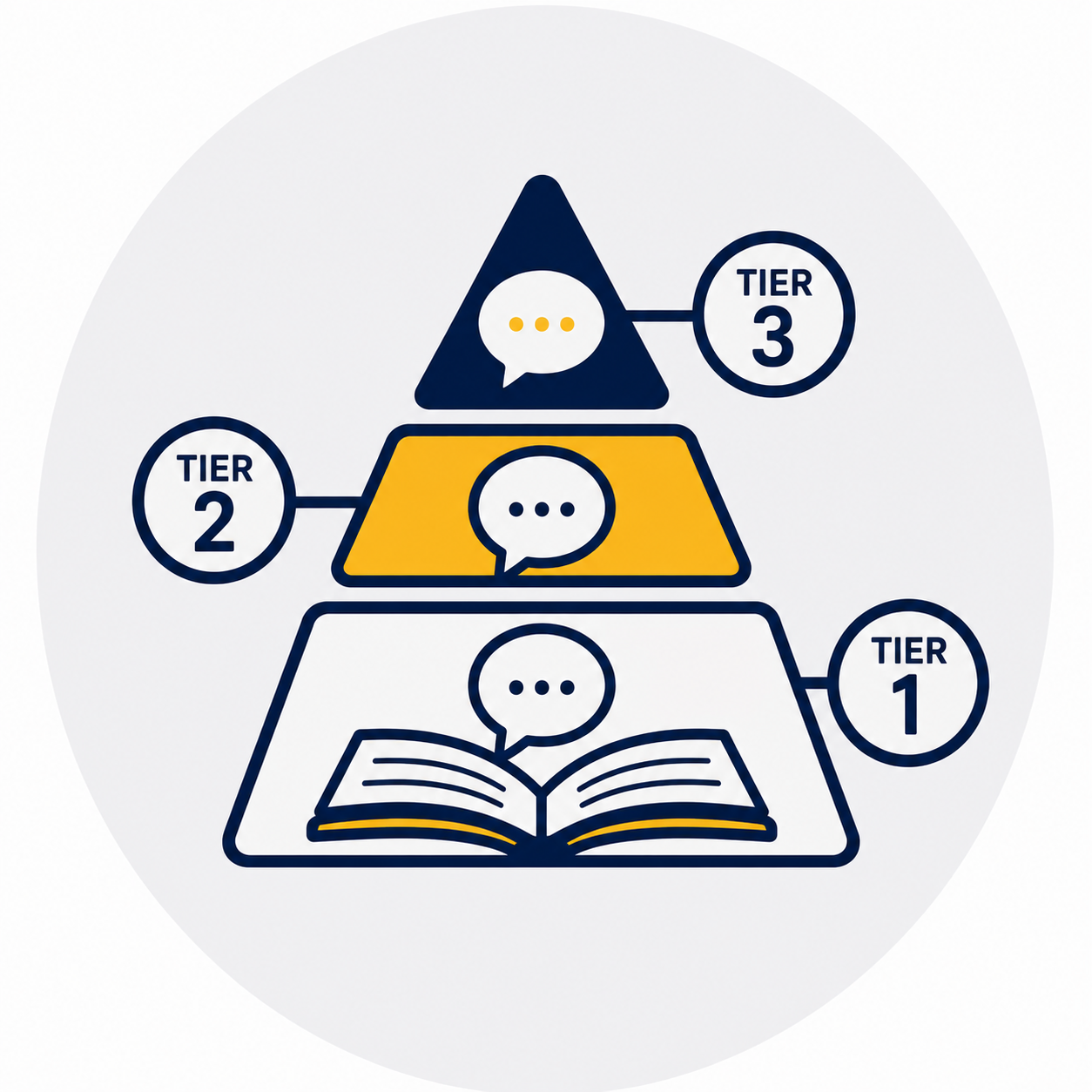
Tier 2 & Tier 3 Vocabulary
Vocabulary is often treated as something pupils simply pick up through wide reading and classroom talk — but for many pupils, that leaves the words a subject depends on to chance. This session explores why precise, ambitious vocabulary matters more than broad vocabulary, and why the gap between word-rich and word-poor pupils widens rather than closes without deliberate teaching. It gives every teacher a practical framework for deciding which words are worth direct teaching time, and which can develop naturally.
[[BIGPICTURE]] Not every unfamiliar word deserves the same teaching time. Sorting vocabulary into everyday words pupils already know, high-utility academic words worth teaching directly, and subject-specific technical words worth pre-teaching gives teachers a clear, repeatable way to decide where their limited time is best spent.[[/BIGPICTURE]]
[[EVIDENCE]] Beck, McKeown and Kucan (2013) established the three-tier model this session is built on, distinguishing everyday, academic and technical vocabulary. Quigley (2018) evidenced the word gap between word-rich and word-poor pupils in UK schools. The EEF (2021) recommends explicit, planned vocabulary teaching as a core Key Stage 2 literacy strategy.[[/EVIDENCE]]
[[THE CLASSROOM IMPACT]] Teachers stop explaining new words once and moving on, and start pre-selecting five to eight key words per unit, explaining them in everyday language, and deliberately bringing them back across weeks. Pupils use taught words unprompted in their own talk and writing, rather than only recognising them on the page.[[/THE CLASSROOM IMPACT]]
[[PERFECT FOR]] Schools looking to close the word gap between word-rich and word-poor pupils, build pupils' independent use of academic vocabulary across every subject, and give every member of staff — including teaching assistants — a shared, deliberate approach to teaching the vocabulary every subject depends on. Available as a 60-minute staff meeting, 90-minute twilight, or 2.5-hour INSET.[[/PERFECT FOR]]
[[KEYWORDS]] tier 2 vocabulary, tier 3 vocabulary, academic vocabulary, word gap, vocabulary instruction, deliberate word selection, student-friendly explanations, planned repeated exposure, teaching word roots and morphology, active pupil use, beck, mckeown, kucan, quigley, eef, closing the vocabulary gap, reading comprehension, eal support, disadvantaged pupils, whole-school cpd. category:literacy.category:curriculum. [[/KEYWORDS]]
-

Vocabulary Practice
Vocabulary is one of the strongest predictors of pupil achievement, yet it is often left to chance rather than taught deliberately. This session explores why word gaps widen rather than close without explicit teaching, what happens when vocabulary is treated as incidental rather than planned, and how a simple four-stage model gives every teacher a practical starting point. Building genuine word knowledge changes how confidently pupils think, talk and write across every subject.
[[BIGPICTURE]]
Vocabulary knowledge isn't picked up through exposure alone — it has to be built, through deliberately choosing which words matter, explaining them simply, and bringing them back so they're genuinely remembered. The words a pupil can confidently use, not just recognise, are what open up every subject to them.[[/BIGPICTURE]]
[[EVIDENCE]]
Beck, McKeown and Kucan (2013) on teaching Tier 2 words explicitly rather than through dictionary definitions; Biemiller (2010) on vocabulary gaps that widen without direct teaching; Marzano (2004) on academic vocabulary instruction raising achievement across every subject; and the EEF (2021) recommending structured vocabulary teaching in KS1–2.[[/EVIDENCE]]
[[THE CLASSROOM IMPACT]]
Teachers stop leaving vocabulary to chance and start pre-teaching three to five key words before each unit, with pupil-friendly explanations in place of dictionary definitions. Pupils use taught words unprompted in talk and writing, explain meanings in their own terms, and access texts and tasks that unfamiliar words previously blocked.[[/THE CLASSROOM IMPACT]]
[[PERFECT FOR]]
Schools looking to close the vocabulary gap for disadvantaged and EAL pupils, and build every child's ability to understand and confidently use academic language across every subject, not just English.[[/PERFECT FOR]]
[[KEYWORDS]] vocabulary practice, vocabulary instruction, word gap, academic vocabulary, tier 2 vocabulary, select and pre-teach tier 2 words, semantic mapping and word webs, teach word parts (morphology), spaced retrieval of taught words, rich talk and purposeful use, beck mckeown kucan, biemiller, marzano, eef, robust vocabulary instruction, eal vocabulary support, reading comprehension, disadvantaged pupils, whole-school cpd, primary literacy.
category:literacy. category:teaching[[/KEYWORDS]] -
Vocabulary Rich Curriculum
Vocabulary is the currency of the whole curriculum, not just English — yet in most primary schools it is still left to chance rather than taught by design. This session explores why word-poor pupils fall further behind word-rich peers with every year that passes, and what changes when schools plan vocabulary deliberately across every subject instead of hoping it develops through incidental exposure alone. For any school serious about closing the word gap, this is where to start.
[[BIGPICTURE]]
Vocabulary is not an English subject job — it is the mechanism through which pupils access every other subject. Left to chance, word-poor pupils fall further behind with every year that passes; taught deliberately, the same words give every pupil the means to read, reason about, and discuss the curriculum.[[/BIGPICTURE]]
[[EVIDENCE]]
The Oxford Language Report (2018) found nearly half of Year 1 pupils already show a limited vocabulary affecting their learning. Beck, McKeown and Kucan (2013) set out the four-part select-explain-expose-use model this session is built on. Quigley (2018) shows over 90% of academic vocabulary has Latin or Greek roots.[[/EVIDENCE]]
[[THE CLASSROOM IMPACT]]
Teachers stop introducing new words once and moving on, and instead plan which words to teach, revisit them across the week, and build in short talk tasks before writing begins. Pupils use taught words unprompted in their own speech and writing, not just when asked to repeat them back.[[/THE CLASSROOM IMPACT]]
[[PERFECT FOR]]
Schools looking to close the vocabulary gap for disadvantaged and EAL pupils, embed a consistent whole-school approach to word selection, and give every child the academic vocabulary they need to access every subject with confidence.[[/PERFECT FOR]]
[[KEYWORDS]] vocabulary rich curriculum, vocabulary gap, word gap, tier 2 vocabulary, academic vocabulary, deliberate tier 2 word selection, student-friendly explanations, repeated varied exposure, teaching word roots and morphology, structured talk for new vocabulary, oxford language report, beck mckeown kucan, quigley, willingham, eef, morphology instruction, oracy, closing the vocabulary gap, whole-school cpd, primary, category:literacy category:curriculum.[[/KEYWORDS]]
-

Working Memory
Working memory is the hidden bottleneck behind everyday classroom learning — the limited mental space every pupil uses to follow instructions, hold ideas in mind, and build new learning onto old. This session explores why lessons unintentionally overload it, why overload is so often mistaken for poor behaviour, and what the evidence says about designing lessons that respect its limits. Understanding working memory helps schools make deliberate, evidence-informed choices about instruction, slide design and lesson pacing.
[[BIGPICTURE]]Working memory can typically hold only around four items at once, and this capacity is largely fixed — it cannot be trained to get bigger. The real lever is reducing the unnecessary load lessons place on it, not trying to expand what pupils can hold.
[[/BIGPICTURE]][[EVIDENCE]]Baddeley and Hitch (1974) on the multi-component model of working memory; Sweller (1988) on cognitive load theory; Gathercole and Alloway (2008) on pupils with low working memory being frequently misidentified as inattentive; and Melby-Lervåg and Hulme (2013), whose meta-analysis found working memory training rarely transfers to classroom learning.
[[/EVIDENCE]][[THE CLASSROOM IMPACT]]Teachers replace long strings of instructions and text-heavy slides with single-step chunking, worked examples and diagrams paired with speech. Pupils repeat instructions back accurately, lose their place less often, and disengagement that once looked like poor behaviour is recognised and addressed as overload instead.
[[/THE CLASSROOM IMPACT]][[PERFECT FOR]]Schools looking to reduce cognitive overload in everyday lessons, help pupils — especially those with SEND or EAL — hold onto instructions the first time, and build a consistent, whole-school approach to lesson and slide design that respects every pupil's working memory limits.
[[/PERFECT FOR]][[KEYWORDS]] working memory, cognitive load, attention, chunking, processing, overload, executive function, short-term memory, dual task, schema, information processing, memory capacity, rehearsal, instruction, cognitive overload category:cognitive category:send[[/KEYWORDS]]
-

Whiteboards as an Assessment Tool
Mini whiteboards are one of the simplest tools sitting in most primary classrooms — but rarely used to their full potential as an assessment method. This session explores why verbal questioning alone leaves most of a class unchecked, what the evidence says about seeing every pupil's understanding in real time, and how five practical strategies turn whiteboards into a genuine formative assessment tool. Understanding this shift helps schools move from sampling a few pupils to checking every one, every time.
[[BIGPICTURE]]
A hands-up answer tells you what one pupil knows — not the whole class. Mini whiteboards let every pupil show their answer at once, converting a single response into whole-class evidence the teacher can act on immediately, rather than a guess.[[/BIGPICTURE]]
[[EVIDENCE]]
Black and Wiliam (1998) found formative assessment produces some of the largest measurable achievement gains identified in classroom research; Wiliam (2011) developed the hinge-question techniques used here; Hattie (2009) ranks feedback among the highest-impact classroom influences; and the EEF (2021) confirms timely, whole-class checks accelerate progress.[[/EVIDENCE]]
[[THE CLASSROOM IMPACT]]
Teachers replace hands-up sampling with a hinge question and simultaneous reveal, seeing every pupil's answer before deciding what happens next. Pupils get no opt-outs — every one writes and shows an answer — and misconceptions are caught and corrected in the lesson, rather than surfacing later in written work.[[/THE CLASSROOM IMPACT]]
[[PERFECT FOR]]
Schools looking to move beyond hands-up questioning, give every pupil a genuine voice in whole-class checks, and catch misconceptions in the moment, before they compound into costly reteaching later in the term.[[/PERFECT FOR]]
[[KEYWORDS]] whiteboard assessment, mini whiteboards, whiteboards as an assessment tool, checking for understanding, formative assessment, hinge questions, show me on three, cold call then show, error spotting, whiteboard sequences, wiliam, black and wiliam, hattie, rosenshine, embedded formative assessment, hands-up questioning, whole-class questioning, cold calling, real-time assessment, primary cpd. category:teaching category:assessment.[[/KEYWORDS]]